

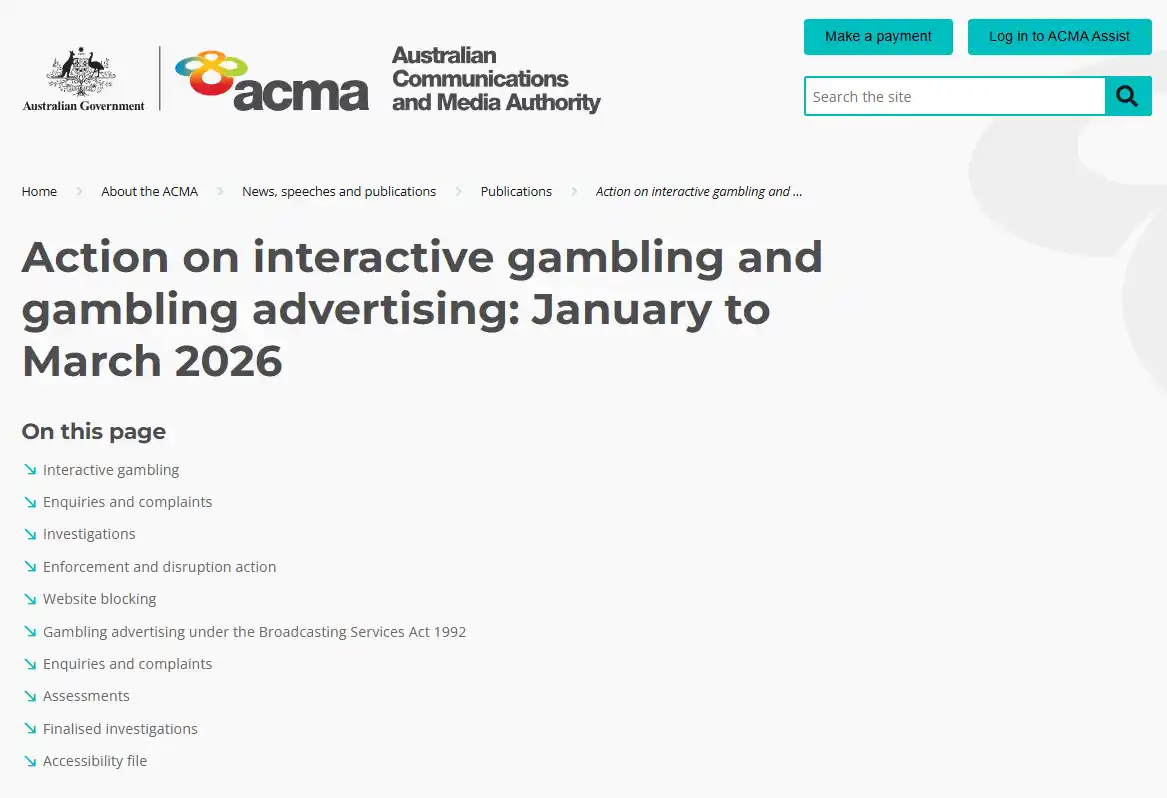
Operational access and Australian legal authorisation are different questions. 7Bit’s current product information does not list Australia among its stated restricted countries, but that does not make 7Bit Casino an Australian-licensed service. ACMA says providers must not offer online casino services to people in Australia, and the current register of licensed interactive wagering providers does not list 7Bit Casino or Scores55. ACMA’s January to March 2026 enforcement report also lists 7bitcasino28.com among 109 websites blocked after investigations into illegal gambling services.
For an Australian reader, the practical conclusion is narrow: 7Bit is not listed as fully legal, ACMA-approved or protected by an Australian wagering licence. The blocking record is evidence about a specific URL and regulator action. It is not, by itself, proof that every 7Bit domain rejects Australian accounts. The distinction matters alongside the current law, the 2026 reform timetable, tax treatment and the scope of Australian safer-gambling tools.
ACMA Regulations for 7Bit Casino Operations
The key federal law is the Interactive Gambling Act 2001. ACMA describes online casinos as a banned service that gambling providers must not offer to people in Australia. The same regulatory framework also distinguishes other forms of interactive gambling. In particular, online wagering can operate as a separately regulated category when the provider holds the required Australian licence and appears on ACMA’s register.
That distinction matters because the words “casino” and “sportsbook” can sit on the same commercial website while Australian law treats the underlying services differently. A product can contain casino games, sports betting and esports within one account, but the existence of those features does not create Australian authorisation. A wagering provider that wants to operate legally in Australia must meet the local licensing framework for that regulated wagering activity.
For 7Bit specifically, the current ACMA register does not show a match for 7Bit or Scores55. That means no Australian local wagering licence is confirmed for the brand on the current register. Readers who want the separate offshore licensing discussion can use the 7Bit licence and trust page. The Australian point is simpler: an offshore licence is not a substitute for Australian licensing or ACMA registration.
The 7bitcasino28.com blocking record
ACMA’s January to March 2026 enforcement report records 109 websites blocked in connection with illegal gambling services. The list includes 7bitcasino28.com. ACMA explains that the blocked sites relate to services found in breach of the Interactive Gambling Act and that the majority are casino-style services, with some also providing wagering without an Australian licence.
This is stronger evidence than a generic warning about offshore gambling because it identifies an exact 7Bit-labelled URL in an official enforcement report. It should still be interpreted precisely. Website blocking is regulator-side disruption of a particular URL. It does not mean that every similarly branded address has the same status on the same date, and it does not prove that the operator has placed Australia on its own account-registration exclusion list.
That is why operational availability and legal status should not be collapsed into one sentence. A site can technically accept traffic or present registration options while Australian law still prohibits the provider from supplying the relevant casino service. Conversely, a regulator block does not automatically tell you what the operator’s current account rules say on every domain. For product features, see the main 7Bit review; Australian compliance depends on the law and regulator records described above.
Australian wagering is a separate regulated category
ACMA’s public guidance says an online wagering service must be on the register of licensed interactive gambling providers to operate legally in Australia. This is the category that covers licensed online and phone wagering, subject to Australian rules and consumer-protection obligations. It is separate from prohibited online casino services.
This matters when reading a site that combines casino and sportsbook features. 7Bit includes sportsbook and esports functionality, but those features do not prove local authorisation. The 7Bit sportsbook and esports guide explains the available product features; Australian licensing remains a separate regulatory question.
For the same reason, payment availability does not establish legality. A cashier can support a payment rail without that rail creating regulatory approval. The 7Bit payment methods guide covers the cashier structure, while the 7Bit crypto payments page covers coins and networks. Neither should be read as evidence of Australian licensing.
Advertising restrictions
ACMA states that ads for prohibited interactive gambling services are banned on television, radio and online in Australia. The ban includes online casino-style services and unlicensed or otherwise prohibited interactive betting services. This is a provider and advertising compliance rule, not an invitation to treat an ad, affiliate page or search result as evidence that a service is locally authorised.
For readers, the practical test is to separate marketing visibility from regulatory status. Seeing a brand promoted to Australians does not mean it appears on ACMA’s licensed wagering register. The register and ACMA’s enforcement publications are the more useful sources for that question. Understanding the legal landscape is crucial, so we also recommend checking the official 7Bit Casino licence and ACMA status to ensure full compliance.
2026 reform timeline: what is in force now and what starts in 2027
The Interactive Gambling Amendment (Gambling Reform) Act 2026 received Royal Assent on 26 August 2026. The commencement table is important because the Act exists now, but most of its substantive changes are not yet operating on 3 September 2026.
| Date | What happens |
|---|---|
| 26 August 2026 | Sections 1 to 4 and provisions not otherwise covered commenced on Royal Assent. |
| 27 August 2026 | Schedule 5 commenced the day after Royal Assent. |
| 1 January 2027 | All other Schedules commence, including the main substantive reform packages. |
The 1 January 2027 date should therefore be described as a future commencement date, not as law already operating in full today. The reform Act contains substantial changes around wagering advertising, disruption of illegal gambling services, BetStop, online lottery products, inducements and a wagering advertising opt-out register. Those changes can affect the broader regulatory environment, but their future commencement does not change the basic current rule that providers must not offer prohibited online casino services to people in Australia.
What the law does not say about individual players
The provider-side rules administered by ACMA should not be turned into a claim that an ordinary Australian player is automatically prosecuted merely for accessing or playing at an offshore online casino. The official guidance cited here is framed around what gambling businesses may provide or advertise and the enforcement tools ACMA can use against illegal services.
That distinction does not make an offshore service safe or locally protected. ACMA warns that illegal gambling services are unlikely to provide the same consumer protections as licensed Australian wagering operators. If a dispute arises with an offshore casino, a user should not assume that the Australian licensing and dispute-resolution protections attached to a locally licensed wagering provider apply.
This also means there is no justification for block-circumvention guidance. VPN, mirror, DNS and similar block-circumvention instructions are not provided. A regulator block is a compliance signal to understand, not a technical obstacle to work around.
Tax: ordinary gambling winnings and crypto
Australian tax treatment is a separate issue from whether the gambling service itself is authorised. ATO guidance says betting and gambling wins are generally not assessable income when a person is not carrying on a business of betting or gambling. The business question depends on the facts and can produce a different result, so a large or systematic activity should not be reduced to a blanket “tax free” slogan.
Crypto adds a second layer. ATO guidance on crypto asset prizes and gambling winnings says capital gains and losses made directly from gambling are generally disregarded. However, if a person wins crypto, keeps it as an investment and later disposes of it, that later disposal can create a capital gain or capital loss. The cost base is generally tied to the market value when the crypto was won.
The practical separation is useful: first ask how the gambling win itself is treated, then ask what happens if the crypto asset is held and later sold, swapped or otherwise disposed of. Supported crypto rails do not determine personal tax outcomes.
Responsible gambling and the BetStop boundary
Australia’s National Consumer Protection Framework for Online Wagering contains 10 consumer-protection measures for Australian-licensed online wagering. One of the major national tools is BetStop, the National Self-Exclusion Register.
BetStop lets people exclude themselves from Australian-licensed online and phone wagering providers. BetStop also states that it does not apply to online casino games or other gambling services that are illegally provided in Australia. That boundary is important here: BetStop is not a universal blocking service for every offshore casino site.
If a reader is considering any gambling product, practical harm-reduction steps remain relevant regardless of the provider: use fixed spending limits, avoid chasing losses, keep gambling separate from essential expenses and step away when play stops being recreational. For account-specific questions such as registration and access, use the 7Bit registration guide rather than assuming that account availability equals local authorisation.
A practical way to verify the Australian position
For a current compliance check, use different sources for different questions. ACMA’s Interactive Gambling Act guidance answers what kinds of online gambling services providers may offer to people in Australia. The licensed interactive wagering register answers whether a wagering provider is locally licensed. ACMA’s quarterly enforcement reports and blocked-site list answer whether a particular domain has been subject to regulator action. These sources are related, but they are not interchangeable.
That separation prevents several common errors. A domain appearing in a blocking report does not automatically tell you the operator’s complete restricted-country list. An offshore licence does not create an Australian licence. A functioning registration page does not prove Australian authorisation. And a sportsbook feature does not turn prohibited casino activity into locally licensed wagering. These points describe different regulatory questions and should not be treated as interchangeable forms of authorisation.
Date precision matters as well. The ACMA blocking record cited comes from the January to March 2026 enforcement period, while the reform Act received assent on 26 August 2026 and most substantive Schedules commence on 1 January 2027. Readers checking the position later should distinguish a historical enforcement record from the current register and current commencement status. Exact dates are important because the enforcement record, register status and reform commencement do not all refer to the same point in time.
Bottom line for Australian readers
The evidence points to a clear legal distinction. The available 7Bit terms do not list Australia among the restricted countries, but ACMA says providers must not offer online casino services to people in Australia. No Australian local wagering licence is verified for 7Bit or Scores55 on the current ACMA register, and ACMA’s January to March 2026 report specifically lists 7bitcasino28.com among blocked illegal gambling websites.
That combination means the accurate description is not “fully legal in Australia” and not “ACMA licensed”. It is an offshore product with documented operational availability on one side and significant Australian regulatory restrictions on the other. The 2026 reform Act adds further changes from 1 January 2027, but those future Schedules should not be described as already in force on 3 September 2026. Navigate the complex regulatory environment safely with the help of our expert Australian online casino portal.